note
How a physics game finds out what it feels like
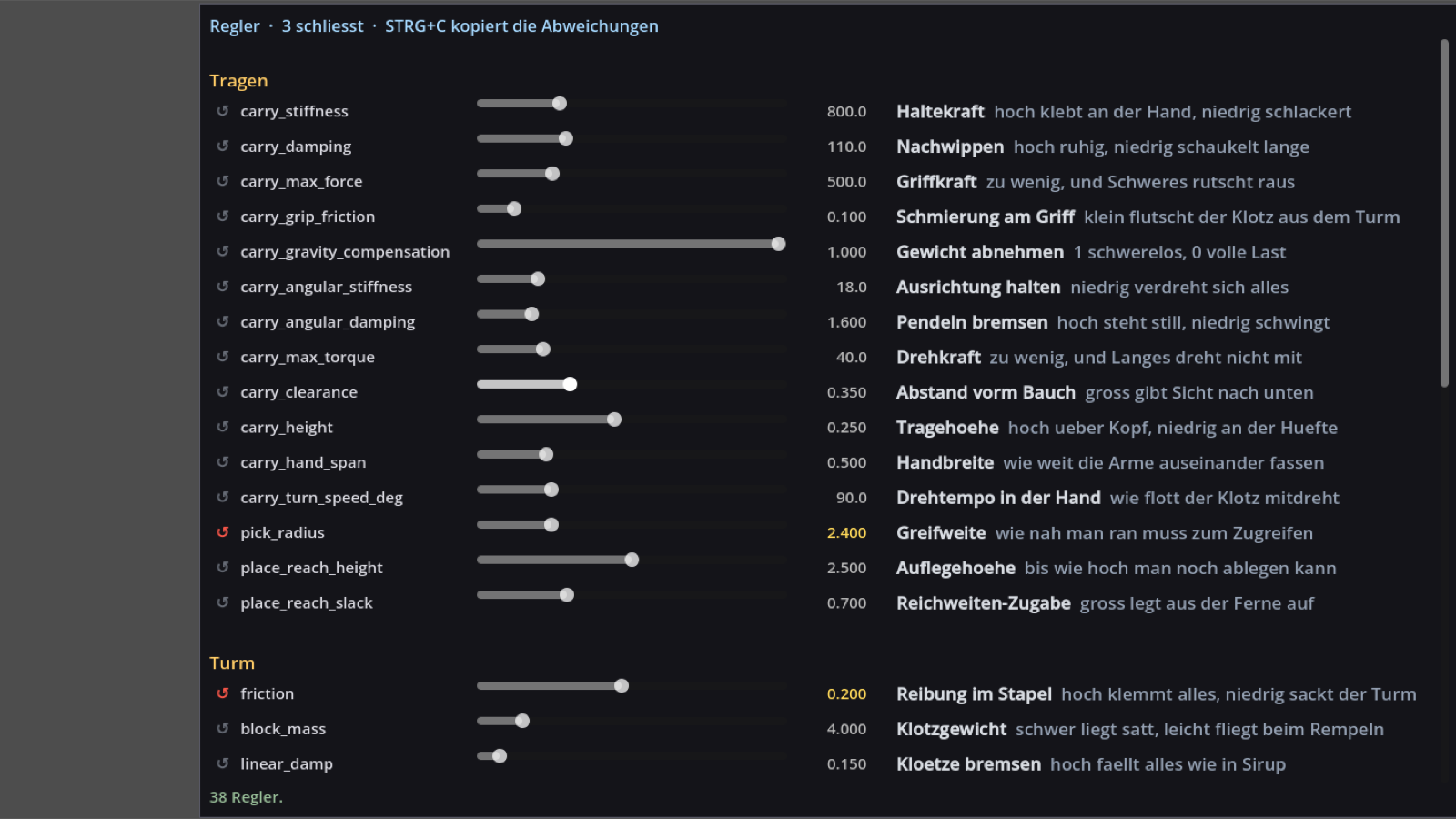
Nobody knows what a good grip strength is. You can reason about it, you can look up what a hand can hold, and then you play for four seconds and find out that the correct answer had nothing to do with any of that. Feel is not a number you derive. It is a number you find.
So there is a panel of sliders in the development build, and it now covers all of it. How hard a hand holds. How far you can reach. How much the block swings behind you when you turn. How heavy you are, how fast you stop, how much the tower resists having a block pulled out of it. Thirty eight of them, live, while the game runs. Change one and the blocks that already exist change with it, which sounds obvious and is the part that took the actual work.
The thing we got right, more by accident than plan, is the column on the right. Every slider says what it does to the game, not what it sets. Not “angular damping” but “stops the block swinging”. Not “reach slack” but “how far out you can place from”. You stop looking for the setting and start looking for the feeling, and those turn out to be different searches.
Each row also has a small arrow that puts that one value back where it started, and the arrow goes red when the value has moved. Twenty minutes into an afternoon of tuning, the honest question is not “what did I set this to” but “what have I touched”. The red arrows answer it without anyone having to remember anything.